Blab Politics
Trumps Claims of Zero Crime in Washington, D.C. Contradicted by Data, but Numbers Show Decline
When President Donald Trump declared Washington, D.C. crime to be virtually nonexistent, he sparked a sharp debate that ran counter to the city’s own crime statistics.
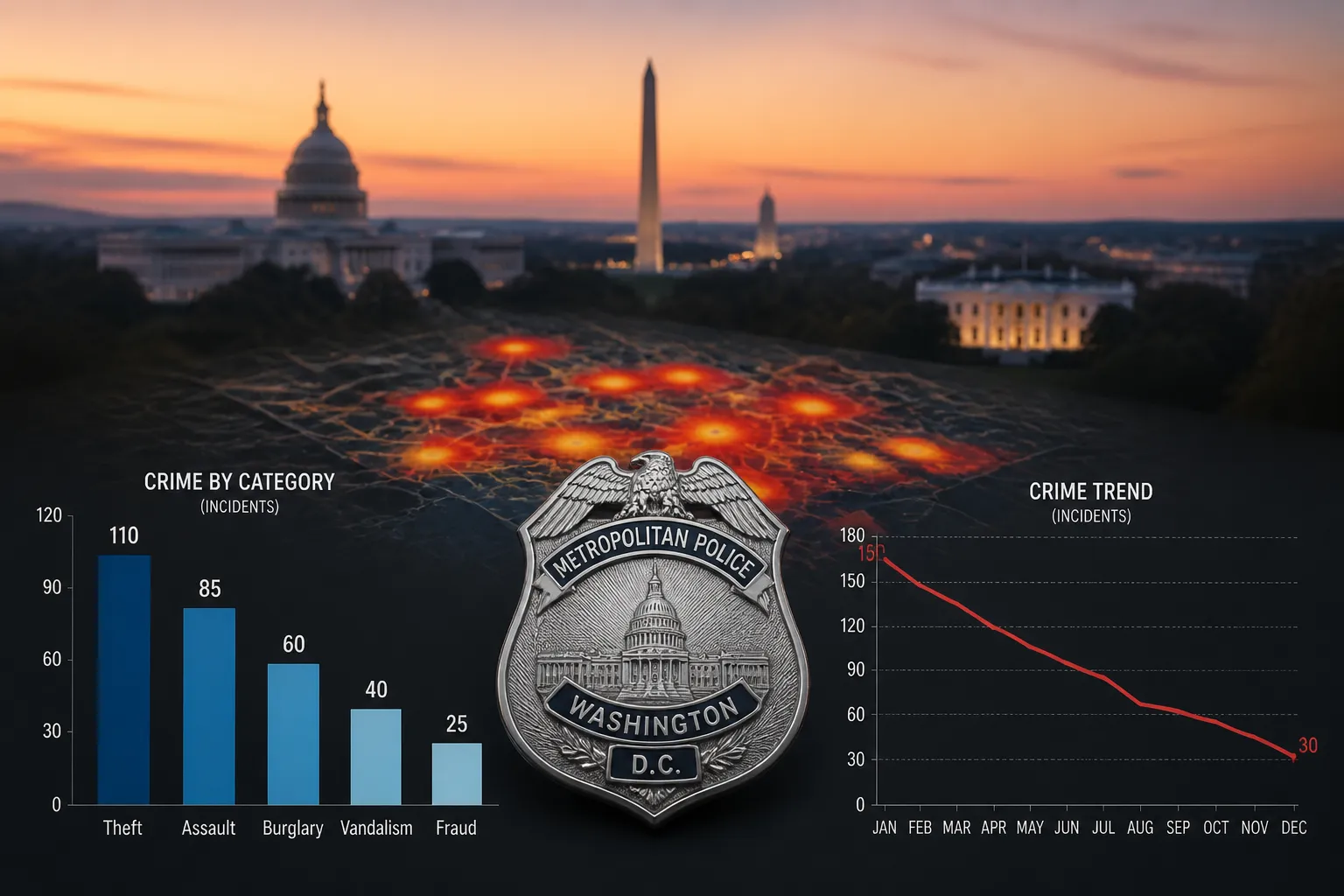
The FBI’s Uniform Crime Report paints a picture of steady improvement. Homicides fell from 274 in 2023 to 187 in 2024 and 127 in 2025. Robberies, which peaked at 3,459 in 2023, dropped to 1,323 in 2025. Motor‑vehicle thefts, which reached 6,799 in 2023, fell to 3,936 in 2025. These figures show a clear downward trend in both violent and property crime over the past two years.
Trump’s narrative, however, does not line up with the data. In a September State of the Union address, he claimed the city’s crime was at the lowest level ever recorded and that murders in January were down “close to 100 %.” The numbers indicate a 31 % decline in homicides from 2023 to 2024 and a 32 % decline from 2024 to 2025—significant but far from a complete wipe‑out.
The president’s argument was bolstered by the deployment of the National Guard. In August 2024, roughly 2,000 Guard soldiers were sent to Washington, Washington, D.C. in a so‑called “crime emergency.” A Department of Defense release described the Guard’s mission as providing a visible presence in key public areas to deter crime. The Guard, however, lacks arrest powers and is not trained for routine policing.
Critics have labeled the deployment “security theater.” Former police chief Darrel Stephens said the Guard was “put in a position where you can’t use the skills and training and knowledge that they have developed to its best use.” Assistant professor Suzanne Goodney Lea called the move a “security theater” that “doesn’t make anything safer.” A Washington Post map shows Guard troops concentrated in Wards 2 and 6—home to the National Mall and the Wharf—rather than the city’s highest‑crime neighborhoods in Wards 7 and 8.
Local officials’ views are mixed. Mayor Muriel Bowser praised the federal surge for its role in a 1,000‑arrest period and an 87 % reduction in car‑jackings during a 20‑day deployment. Yet she also criticized masked ICE agents and argued the Guard’s presence was an inefficient use of resources. In November, she supported a federal judge’s ruling that the deployment was unlawful.
Residents echo the divided sentiment. Capitol Hill resident Claudia Anderson said the Guard’s presence was “nice” but questioned its purpose. Southwest resident Jeff Nold said he does not believe the Guard has helped and called its presence “unwarranted and very expensive.” Another resident, Steve Lloyd, said he does not mind the Guard and believes the city has been safe.
Data reliability remains a concern. The FBI’s UCR relies on crimes reported to local jurisdictions, while the DOJ’s National Crime Victimization Survey surveys individuals about their experiences. Discrepancies between the two systems are well documented, and some cities have been found to underreport or misclassify crimes. In 2025, D.C. police commander Michael Pulliam was suspended after accusations that he had manipulated crime data.
The National Guard’s impact on crime is unclear. A Niskanen Center analysis found the Guard’s presence produced a significant decline in opportunistic property crime but had a negligible effect on violent crime. The study emphasized that policing effectiveness depends on where officers are deployed and what they do, not merely on the number of officers.
In sum, Washington, D.C. crime has declined over the past two years, but the decline is not a 100 % reduction and is not solely attributable to the National Guard. The Guard’s deployment has been criticized for being misaligned with the city’s most serious crime areas and for lacking arrest authority. The District’s police department continues to face scrutiny over data reporting, and the legal status of the Guard’s presence remains contested. The next steps involve ongoing investigations into data manipulation, court rulings on federal deployments, and the city’s efforts to maintain public safety while respecting local governance.
The FBI’s Uniform Crime Report paints a picture of steady improvement. Homicides fell from 274 in 2023 to 187 in 2024 and 127 in 2025. Robberies, which peaked at 3,459 in 2023, dropped to 1,323 in 2025. Motor‑vehicle thefts, which reached 6,799 in 2023, fell to 3,936 in 2025. These figures show a clear downward trend in both violent and property crime over the past two years.
Trump’s narrative, however, does not line up with the data. In a September State of the Union address, he claimed the city’s crime was at the lowest level ever recorded and that murders in January were down “close to 100 %.” The numbers indicate a 31 % decline in homicides from 2023 to 2024 and a 32 % decline from 2024 to 2025—significant but far from a complete wipe‑out.
The president’s argument was bolstered by the deployment of the National Guard. In August 2024, roughly 2,000 Guard soldiers were sent to Washington, Washington, D.C. in a so‑called “crime emergency.” A Department of Defense release described the Guard’s mission as providing a visible presence in key public areas to deter crime. The Guard, however, lacks arrest powers and is not trained for routine policing.
Critics have labeled the deployment “security theater.” Former police chief Darrel Stephens said the Guard was “put in a position where you can’t use the skills and training and knowledge that they have developed to its best use.” Assistant professor Suzanne Goodney Lea called the move a “security theater” that “doesn’t make anything safer.” A Washington Post map shows Guard troops concentrated in Wards 2 and 6—home to the National Mall and the Wharf—rather than the city’s highest‑crime neighborhoods in Wards 7 and 8.
Local officials’ views are mixed. Mayor Muriel Bowser praised the federal surge for its role in a 1,000‑arrest period and an 87 % reduction in car‑jackings during a 20‑day deployment. Yet she also criticized masked ICE agents and argued the Guard’s presence was an inefficient use of resources. In November, she supported a federal judge’s ruling that the deployment was unlawful.
Residents echo the divided sentiment. Capitol Hill resident Claudia Anderson said the Guard’s presence was “nice” but questioned its purpose. Southwest resident Jeff Nold said he does not believe the Guard has helped and called its presence “unwarranted and very expensive.” Another resident, Steve Lloyd, said he does not mind the Guard and believes the city has been safe.
Data reliability remains a concern. The FBI’s UCR relies on crimes reported to local jurisdictions, while the DOJ’s National Crime Victimization Survey surveys individuals about their experiences. Discrepancies between the two systems are well documented, and some cities have been found to underreport or misclassify crimes. In 2025, D.C. police commander Michael Pulliam was suspended after accusations that he had manipulated crime data.
The National Guard’s impact on crime is unclear. A Niskanen Center analysis found the Guard’s presence produced a significant decline in opportunistic property crime but had a negligible effect on violent crime. The study emphasized that policing effectiveness depends on where officers are deployed and what they do, not merely on the number of officers.
In sum, Washington, D.C. crime has declined over the past two years, but the decline is not a 100 % reduction and is not solely attributable to the National Guard. The Guard’s deployment has been criticized for being misaligned with the city’s most serious crime areas and for lacking arrest authority. The District’s police department continues to face scrutiny over data reporting, and the legal status of the Guard’s presence remains contested. The next steps involve ongoing investigations into data manipulation, court rulings on federal deployments, and the city’s efforts to maintain public safety while respecting local governance.