Blab Politics
Five States Compete to Host U.S. Nuclear Lifecycle Innovation Campuses, Each Proposing Different Waste-Disposal Plans
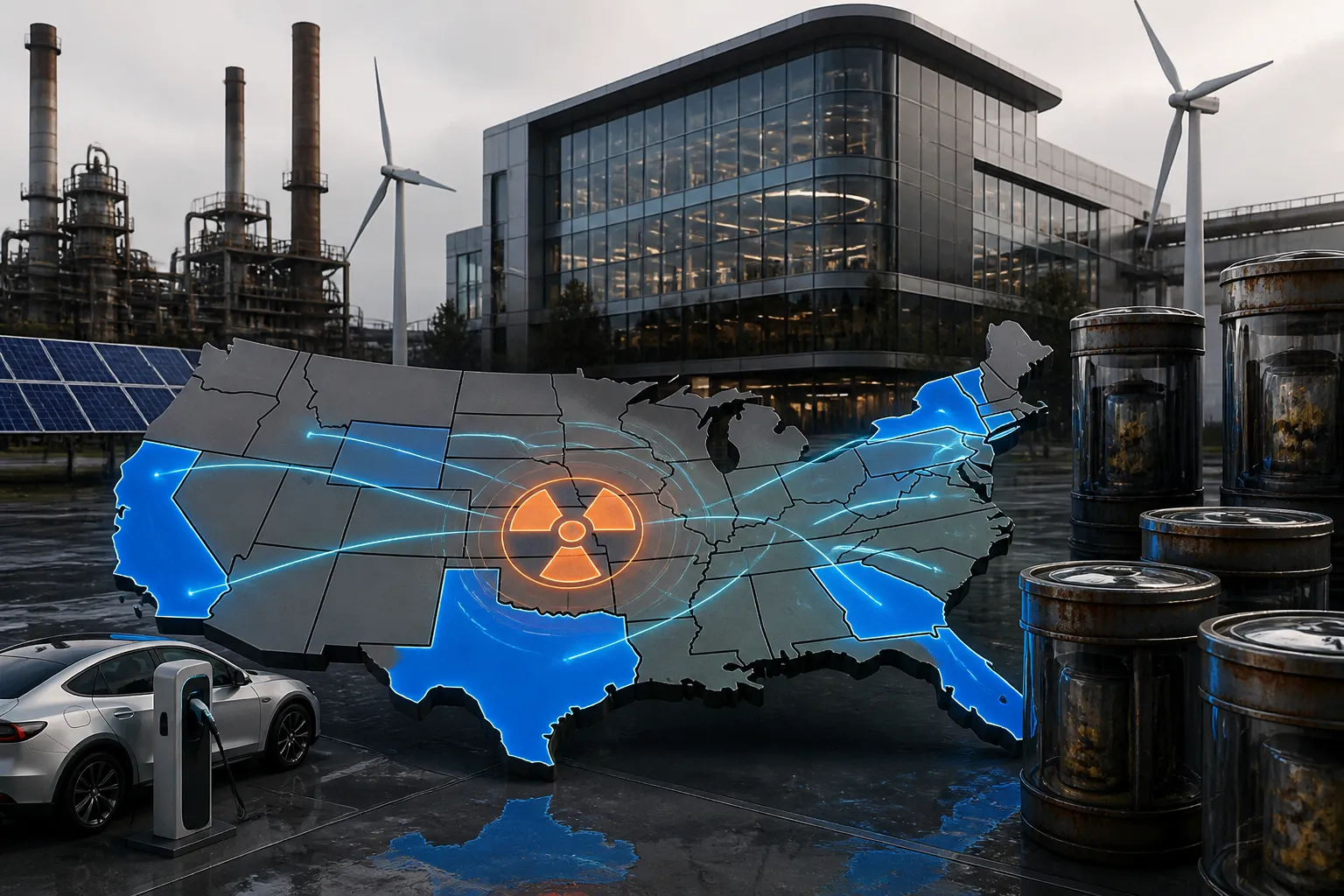
On July 28, the U.S. Department of Energy (DOE) named Oklahoma, Louisiana, Idaho, Tennessee and Utah as finalists for its new Nuclear Lifecycle Innovation Campus (NLIC) program. The plan would bring together fuel fabrication, enrichment, reprocessing and waste‑disposal facilities in a single site, and DOE said each campus could draw up to $50 billion in investment, generate $25 billion in tax revenue and create 25,000 jobs.
The states’ proposals differ mainly in how they intend to deal with spent nuclear fuel that cannot be reprocessed. Oklahoma’s plan is the most aggressive: it would drill 18‑inch boreholes in the Anadarko sedimentary basin and load waste canisters until the holes are full. The state also seeks to partner with California start‑up Oklo, which reprocesses fuel, and Deep Isolation, a company that has studied borehole disposal. Oklahoma officials say the basin meets Deep Isolation’s preliminary screening criteria, although a 2020 study by former NRC chair Allison Macfarlane noted that the basin’s shale‑gas reservoirs and earthquake risk could pose problems.
Louisiana would store waste in salt domes beneath the Gulf of Mexico. Gov. Jeff Landry’s proposal would place canisters more than three miles offshore, a distance that could raise costs and recovery challenges. The idea follows a 1987 veto by then‑Sen. J. Bennett Johnston, who redirected Louisiana’s waste to Nevada’s Yucca Mountain. Republican Sen. John Kennedy said he needed more information before supporting the plan.
Idaho’s campus would build on the Idaho National Laboratory’s existing nuclear expertise but does not include a permanent repository. The state’s 113‑page report says it would consider deep‑borehole storage if the DOE offered significant financial support. Idaho’s Lt. Gov. Scott Bedke praised the proposal as an opportunity to revive the state’s nuclear legacy, while Senate Minority Leader Melissa Wintrow warned that Idaho could be forced to take on a large share of the nation’s spent fuel without clear long‑term storage solutions.
Tennessee would center its campus on Oak Ridge, a long‑standing nuclear research hub. The state would mine a repository on the Cumberland Plateau 25–75 miles west of Oak Ridge. Tennessee officials point to existing partnerships with Radiant Nuclear and Oklo, and to a planned Orano enrichment plant. Republican Sen. Marsha Blackburn highlighted Oak Ridge’s history as a “strong contender” for the campus.
Utah would locate the campus in Tooele County, west of Salt Lake City. The state would drill boreholes in the Tooele Valley and, as a secondary option, mine a repository in salt domes in Millard County. Senate President J. Stuart Adams said the campus would create high‑paying jobs, while Senate Minority Leader Luz Escamilla criticized the Trump administration’s handling of the Great Salt Lake and urged federal protection of the area.
All five states view fuel enrichment and reprocessing as economic opportunities, but the political and financial hurdles of long‑term waste disposal remain. The DOE’s NLIC program is part of a broader effort to revive the U.S. nuclear fuel cycle after the Yucca Mountain project was stalled by state opposition and congressional cuts. Nevada’s Democratic senators recently introduced the Jobs, Not Waste Act, which would prohibit Yucca Mountain from being considered a permanent repository.
The DOE said it would offer technical expertise, cost‑sharing or loan guarantees to campuses that sign hosting agreements later in 2026. The agency also reiterated that each campus could generate up to $50 billion in capital investment, $25 billion in tax revenue and 25,000 jobs.
The final selection of host states will be announced by the end of 2026. Until then, the five finalists are preparing detailed proposals and engaging with federal officials, industry partners and local stakeholders. The debate over waste‑disposal methods—boreholes, salt domes, underwater storage or mined repositories—highlights the technical, environmental and political challenges that still surround the U.S. nuclear industry. The outcome of the NLIC selection will shape the next decade of nuclear development and waste management in the United States.
The states’ proposals differ mainly in how they intend to deal with spent nuclear fuel that cannot be reprocessed. Oklahoma’s plan is the most aggressive: it would drill 18‑inch boreholes in the Anadarko sedimentary basin and load waste canisters until the holes are full. The state also seeks to partner with California start‑up Oklo, which reprocesses fuel, and Deep Isolation, a company that has studied borehole disposal. Oklahoma officials say the basin meets Deep Isolation’s preliminary screening criteria, although a 2020 study by former NRC chair Allison Macfarlane noted that the basin’s shale‑gas reservoirs and earthquake risk could pose problems.
Louisiana would store waste in salt domes beneath the Gulf of Mexico. Gov. Jeff Landry’s proposal would place canisters more than three miles offshore, a distance that could raise costs and recovery challenges. The idea follows a 1987 veto by then‑Sen. J. Bennett Johnston, who redirected Louisiana’s waste to Nevada’s Yucca Mountain. Republican Sen. John Kennedy said he needed more information before supporting the plan.
Idaho’s campus would build on the Idaho National Laboratory’s existing nuclear expertise but does not include a permanent repository. The state’s 113‑page report says it would consider deep‑borehole storage if the DOE offered significant financial support. Idaho’s Lt. Gov. Scott Bedke praised the proposal as an opportunity to revive the state’s nuclear legacy, while Senate Minority Leader Melissa Wintrow warned that Idaho could be forced to take on a large share of the nation’s spent fuel without clear long‑term storage solutions.
Tennessee would center its campus on Oak Ridge, a long‑standing nuclear research hub. The state would mine a repository on the Cumberland Plateau 25–75 miles west of Oak Ridge. Tennessee officials point to existing partnerships with Radiant Nuclear and Oklo, and to a planned Orano enrichment plant. Republican Sen. Marsha Blackburn highlighted Oak Ridge’s history as a “strong contender” for the campus.
Utah would locate the campus in Tooele County, west of Salt Lake City. The state would drill boreholes in the Tooele Valley and, as a secondary option, mine a repository in salt domes in Millard County. Senate President J. Stuart Adams said the campus would create high‑paying jobs, while Senate Minority Leader Luz Escamilla criticized the Trump administration’s handling of the Great Salt Lake and urged federal protection of the area.
All five states view fuel enrichment and reprocessing as economic opportunities, but the political and financial hurdles of long‑term waste disposal remain. The DOE’s NLIC program is part of a broader effort to revive the U.S. nuclear fuel cycle after the Yucca Mountain project was stalled by state opposition and congressional cuts. Nevada’s Democratic senators recently introduced the Jobs, Not Waste Act, which would prohibit Yucca Mountain from being considered a permanent repository.
The DOE said it would offer technical expertise, cost‑sharing or loan guarantees to campuses that sign hosting agreements later in 2026. The agency also reiterated that each campus could generate up to $50 billion in capital investment, $25 billion in tax revenue and 25,000 jobs.
The final selection of host states will be announced by the end of 2026. Until then, the five finalists are preparing detailed proposals and engaging with federal officials, industry partners and local stakeholders. The debate over waste‑disposal methods—boreholes, salt domes, underwater storage or mined repositories—highlights the technical, environmental and political challenges that still surround the U.S. nuclear industry. The outcome of the NLIC selection will shape the next decade of nuclear development and waste management in the United States.