Blab Politics
Tsipras New Party Pushes Luxury Tax as New Democracy Holds Lead in Latest Polls
A fresh political force has entered Greece’s arena: former prime minister Alexis Tsipras, now at the helm of a newly formed party, has unveiled a proposal that could raise the state’s coffers by targeting the wealthy. The plan, drafted by an executive of the Tsipras Institute, calls for a tax on luxury goods—yachts, high‑engine cars and the like—and estimates that it could generate about €600 million for the treasury.
The luxury‑tax idea arrives at a time when the current government, led by Prime Minister Kyriakos Mitsotakis, has been pursuing a policy of tax cuts and reduced contributions. Critics of the proposal point out that many luxury vessels and high‑end automobiles are registered under foreign flags or through offshore companies, and that such assets already fall under special tax regimes. The debate has highlighted the tension between revenue‑generation initiatives and the perception that the wealthiest citizens already bear a heavier fiscal burden.
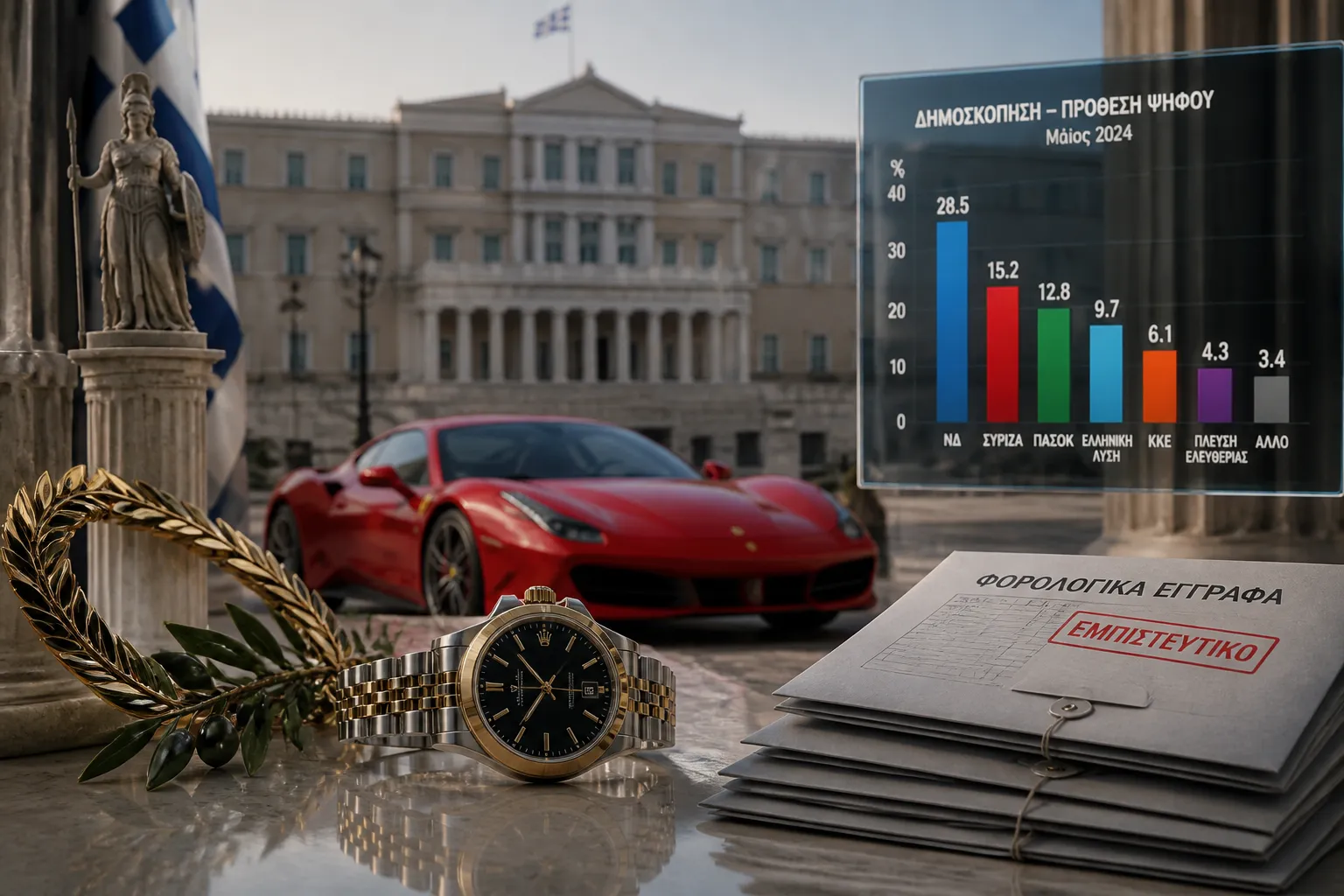
In the lead‑up to the national elections, opinion polls suggest that New Democracy remains the front‑runner. A recent survey of 4,000 respondents in Attica found that the party enjoys roughly 29 % support, while Tsipras’s new coalition trails at about 15 %. PASOK and the Movement for Change are competing for the 8.5‑10 % range, with their strength varying by constituency. The poll also revealed that New Democracy’s core support is concentrated in Western Attica and Piraeus—areas traditionally associated with working‑class voters.
Meanwhile, Greek political activity has spilled over into the European stage. President of the Eurogroup, Kyriakos Pierrakakis, flew to Budapest on Thursday to discuss Hungary’s plans to join the eurozone. The visit was welcomed by Hungarian Prime Minister Viktor Magyar, who said his country is ready to become the 22nd euro‑zone member after Bulgaria’s accession earlier this year. Pierrakakis met with Magyar and other officials to outline the structural adjustments required for euro adoption, underscoring the broader context in which Greece’s domestic politics are unfolding.
Back home, the composition of parliamentary lists has come under scrutiny. Several MPs have voiced concern about the potential inclusion of deputy regional governors—positions that attract significant preference votes—in the lists. The issue has sparked discussion within the New Democracy caucus about amending the Local Government Code to render the office of deputy regional governor incompatible with parliamentary candidacy. Critics argue that such a change would demand a constitutional revision, not merely a legislative tweak.
The debate over regional representation has been especially intense in Pieria, where former deputy minister Anna Mani‑Papadimitriou and MP Koulkoudinas have led a coalition of MPs from Achaia, Boeotia, and Serres to push for the amendment. Minister Livanios has indicated that any change would need to be grounded in Article 56 of the Constitution. As the election campaign intensifies, voters are being asked to weigh tax policy, regional representation, and the broader narrative of fiscal fairness. The luxury‑tax proposal from Tsipras’s new party is poised to shape perceptions in urban areas where high living costs loom large, while New Democracy’s focus on tax cuts and economic growth continues to resonate in the southern and eastern parts of Attica.
The next steps for the parties involve finalizing their platforms, engaging in televised debates, and mobilizing grassroots support ahead of the scheduled elections. Polls suggest that New Democracy’s advantage may be challenged if the opposition can consolidate its message on tax fairness and economic opportunity. With developments unfolding both domestically and across the European stage, the political landscape remains fluid as Greece heads toward its upcoming electoral showdown.
The luxury‑tax idea arrives at a time when the current government, led by Prime Minister Kyriakos Mitsotakis, has been pursuing a policy of tax cuts and reduced contributions. Critics of the proposal point out that many luxury vessels and high‑end automobiles are registered under foreign flags or through offshore companies, and that such assets already fall under special tax regimes. The debate has highlighted the tension between revenue‑generation initiatives and the perception that the wealthiest citizens already bear a heavier fiscal burden.
In the lead‑up to the national elections, opinion polls suggest that New Democracy remains the front‑runner. A recent survey of 4,000 respondents in Attica found that the party enjoys roughly 29 % support, while Tsipras’s new coalition trails at about 15 %. PASOK and the Movement for Change are competing for the 8.5‑10 % range, with their strength varying by constituency. The poll also revealed that New Democracy’s core support is concentrated in Western Attica and Piraeus—areas traditionally associated with working‑class voters.
Meanwhile, Greek political activity has spilled over into the European stage. President of the Eurogroup, Kyriakos Pierrakakis, flew to Budapest on Thursday to discuss Hungary’s plans to join the eurozone. The visit was welcomed by Hungarian Prime Minister Viktor Magyar, who said his country is ready to become the 22nd euro‑zone member after Bulgaria’s accession earlier this year. Pierrakakis met with Magyar and other officials to outline the structural adjustments required for euro adoption, underscoring the broader context in which Greece’s domestic politics are unfolding.
Back home, the composition of parliamentary lists has come under scrutiny. Several MPs have voiced concern about the potential inclusion of deputy regional governors—positions that attract significant preference votes—in the lists. The issue has sparked discussion within the New Democracy caucus about amending the Local Government Code to render the office of deputy regional governor incompatible with parliamentary candidacy. Critics argue that such a change would demand a constitutional revision, not merely a legislative tweak.
The debate over regional representation has been especially intense in Pieria, where former deputy minister Anna Mani‑Papadimitriou and MP Koulkoudinas have led a coalition of MPs from Achaia, Boeotia, and Serres to push for the amendment. Minister Livanios has indicated that any change would need to be grounded in Article 56 of the Constitution. As the election campaign intensifies, voters are being asked to weigh tax policy, regional representation, and the broader narrative of fiscal fairness. The luxury‑tax proposal from Tsipras’s new party is poised to shape perceptions in urban areas where high living costs loom large, while New Democracy’s focus on tax cuts and economic growth continues to resonate in the southern and eastern parts of Attica.
The next steps for the parties involve finalizing their platforms, engaging in televised debates, and mobilizing grassroots support ahead of the scheduled elections. Polls suggest that New Democracy’s advantage may be challenged if the opposition can consolidate its message on tax fairness and economic opportunity. With developments unfolding both domestically and across the European stage, the political landscape remains fluid as Greece heads toward its upcoming electoral showdown.







