Blab Politics
Students Protest at Jantar Mantar Demand Education Ministers Resignation Over NEET Scandal
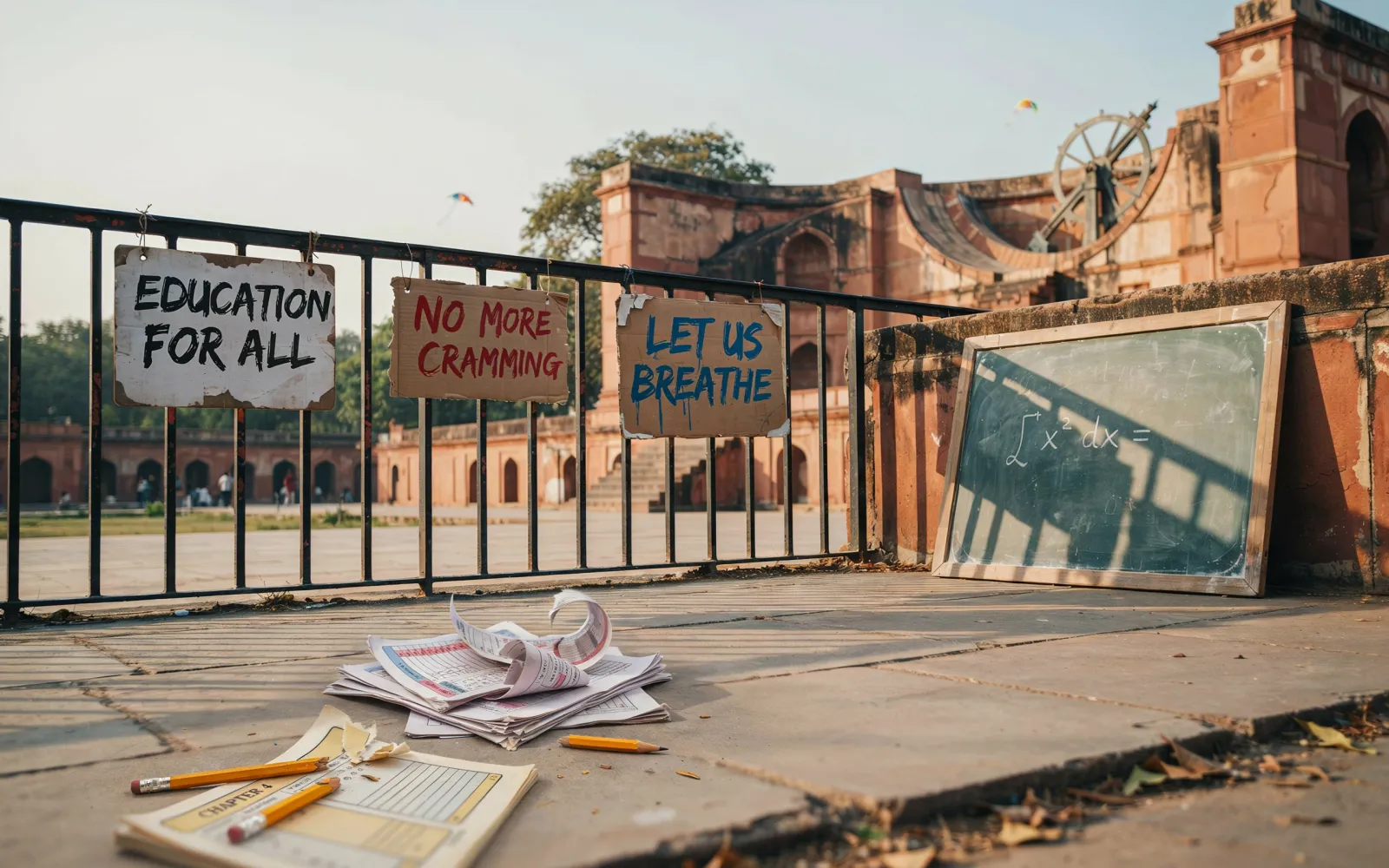
Hundreds of young Indians converged on Saturday at Delhi’s Jantar Mantar, the historic observatory that has long served as a stage for political dissent, to call for the resignation of Union Education Minister Dharmendra Pradhan. The demonstration, organized by the newly formed Cockroach Janta Party (CJP), erupted amid a wave of controversies surrounding the National Eligibility cum Entrance Test (NEET) for undergraduate medical courses.
The NEET‑UG 2026 exam, slated for May 3, was canceled after a paper leak came to light. The National Testing Agency (NTA) warned of scams and announced the exam would not be held. According to reports, the Central Bureau of Investigation (CBI) has detained individuals suspected of distributing leaked question papers, and the NTA confirmed that the leaked material included 140 questions that matched a “guess paper” circulated in Rajasthan. The leak has been linked to student suicides and a broader erosion of confidence in the examination system.
The CJP was founded on May 16 by political communications strategist Abhijeet Dipke, a former Aam Aadmi Party operative. The movement sprang from a Supreme Court hearing in which Chief Justice Surya Kant described certain activists and unemployed youth as “cockroaches” and “parasites of society.” Dipke turned the remark into a satirical protest movement, and within days the CJP amassed more than 350,000 sign‑ups and over 20 million followers on Instagram. Protesters at Jantar Mantar donned cockroach masks and carried dog‑eared exam guides, translating an online meme factory into a physical demonstration.
Police deployed riot gear and steel barricades at the protest site, underscoring the seriousness of the demonstration. Participants waved the Indian flag, held schoolbooks, and chanted slogans demanding Pradhan’s resignation. CJP spokesperson Ashutosh Ranka described the movement as “a new political language for frustrated youth.” The protest marked the CJP’s first large‑scale street demonstration.
Pradhan’s resignation has found support from several political figures. Karnataka Minister Eshwar Khandre publicly urged the minister to step down after the NEET paper leak. Rahul Gandhi, the opposition leader, called for Pradhan’s sacking and urged Prime Minister Narendra Modi to hold the education minister accountable. Other state leaders, including Karnataka Chief Minister Siddaramaiah, have echoed similar demands.
The NTA’s advisory and the CBI’s arrests are part of a broader investigation into the integrity of the NEET examination process. The NTA warned candidates not to rely on leaked materials and stated that any attempt to use such papers would be treated as a criminal offense. Meanwhile, the Supreme Court has not yet issued a ruling on the extent of the leak, though it has acknowledged that isolated incidents have occurred.
At present, the protest remains ongoing, and the Ministry of Education has issued no official response to the demands. The CBI continues to investigate alleged masterminds behind the leak, and the NTA is reviewing its security protocols. The next steps in the legal process are unclear, but the protests are likely to intensify as more evidence emerges.
The Jantar Mantar demonstration represents a significant moment in India’s political landscape, illustrating how a satirical online movement can translate into a mass protest. Whether the calls for Pradhan’s resignation will trigger a cabinet reshuffle or prompt broader reforms of the NEET examination system remains to be seen.
The NEET‑UG 2026 exam, slated for May 3, was canceled after a paper leak came to light. The National Testing Agency (NTA) warned of scams and announced the exam would not be held. According to reports, the Central Bureau of Investigation (CBI) has detained individuals suspected of distributing leaked question papers, and the NTA confirmed that the leaked material included 140 questions that matched a “guess paper” circulated in Rajasthan. The leak has been linked to student suicides and a broader erosion of confidence in the examination system.
The CJP was founded on May 16 by political communications strategist Abhijeet Dipke, a former Aam Aadmi Party operative. The movement sprang from a Supreme Court hearing in which Chief Justice Surya Kant described certain activists and unemployed youth as “cockroaches” and “parasites of society.” Dipke turned the remark into a satirical protest movement, and within days the CJP amassed more than 350,000 sign‑ups and over 20 million followers on Instagram. Protesters at Jantar Mantar donned cockroach masks and carried dog‑eared exam guides, translating an online meme factory into a physical demonstration.
Police deployed riot gear and steel barricades at the protest site, underscoring the seriousness of the demonstration. Participants waved the Indian flag, held schoolbooks, and chanted slogans demanding Pradhan’s resignation. CJP spokesperson Ashutosh Ranka described the movement as “a new political language for frustrated youth.” The protest marked the CJP’s first large‑scale street demonstration.
Pradhan’s resignation has found support from several political figures. Karnataka Minister Eshwar Khandre publicly urged the minister to step down after the NEET paper leak. Rahul Gandhi, the opposition leader, called for Pradhan’s sacking and urged Prime Minister Narendra Modi to hold the education minister accountable. Other state leaders, including Karnataka Chief Minister Siddaramaiah, have echoed similar demands.
The NTA’s advisory and the CBI’s arrests are part of a broader investigation into the integrity of the NEET examination process. The NTA warned candidates not to rely on leaked materials and stated that any attempt to use such papers would be treated as a criminal offense. Meanwhile, the Supreme Court has not yet issued a ruling on the extent of the leak, though it has acknowledged that isolated incidents have occurred.
At present, the protest remains ongoing, and the Ministry of Education has issued no official response to the demands. The CBI continues to investigate alleged masterminds behind the leak, and the NTA is reviewing its security protocols. The next steps in the legal process are unclear, but the protests are likely to intensify as more evidence emerges.
The Jantar Mantar demonstration represents a significant moment in India’s political landscape, illustrating how a satirical online movement can translate into a mass protest. Whether the calls for Pradhan’s resignation will trigger a cabinet reshuffle or prompt broader reforms of the NEET examination system remains to be seen.